Author: Shelley

  • Tips to Hike Safely with Your Dog

    Photo Courtesy of Canva

    There is no bad time to get out and explore the world (or at least take some hikes around your home). Many people love hiking in the spring, because they enjoy getting out after a long winter. Others prefer the summer because they have plenty of extra time to explore. Then, there are others who enjoy spending time out in nature when the temperatures start to cool off. They also enjoy watching the leaves change color in the fall. 

    What could be better than taking our beloved dog along for the hike? Nothing, really, unless you are not prepared. Here are some tips to make sure that you have a safe hike with your dog.

    Make sure that your dog is ready for it. 

    It is important that you take into consideration the health of your dog. Does your dog love to run and play outside for hours? Then, a hike may be fun for both of you.

    Your puppy or older dog may not be able to go for miles! The puppy may not have enough endurance, and your older dog may have some arthritis, which may be holding him or her back. Your smaller dog may struggle with a long walk, especially if you are a fast walker. Shorter walks on flat surfaces may be fine for puppies, older dogs, and small dogs.

    Make sure that your dog is well-trained before heading out on a hike. 

    Your dog needs to know some basic commands while out on the trail. At the very least, your dog should know how to stop, stay, and come.

    Dogo App

    If your dog needs some extra training before you venture out, you may want to check out Dogo’s tailored training programs. After taking a survey, you will receive a customized training plan for you and your dog. They also offer courses for your new dog, no biting, potty training, basic obedience, tricks, and more! 

    Then, don’t forget to plan where you are going. 

    You should never just decide to go for a hike with (or without) your dog. Instead, you should have a plan, along with a map of the route that you are taking.

    While doing this, you will be able to find out if you and your dog are in good enough shape to complete the route. You may want to talk to others who have traveled that way, to make sure that the footing is good. They may also be able to tell you about things that you need to look out for.

    Photo Courtesy of Canva

    On the day of your hike, you should check the local weather reports to make sure that you will have good weather that day. 

    If they are calling for rain, you may want to stick to a shorter hike if you decide that you want to head out anyway.

    Always, always, always let someone know where you are going. 

    Though you may not be a child telling your parents where you are going, the truth is that it is a good idea to let someone know your plan. That way, if you don’t come home when you are supposed to, someone will know to come looking for you.

    Take enough supplies along. 

    You should bring water and snacks on every hike that you take. This also goes for your dog. He or she is going to need water to keep going, too. You can’t just assume that your dog will find water in the creeks and streams where you are going. Not all of these water sources are safe for your dog to drink from.

    You also need to carry a bowl around for him or her to drink out of. Lucky for you, they make collapsible bowls that you can easily carry on your hikes.

    Amazon offers this all-in-one dog travel set, which includes two collapsible bowls, a water bottle, and even a treat bag, to keep your dog happy on the trail all day long!

    Product Available on Amazon

    Make sure that your dog is protected against fleas and ticks before heading out. 

    The truth is that your dog should be protected all year long against these nasty critters. That being said, many people don’t give the preventative during the fall and winter. However, the fall can be the worst time for fleas and ticks, because they are looking for a warm place to live.

    You and your dog could get infected with a disease carried by ticks, such as Lyme disease. Flea bites can cause a lot of problems, including itchy and sensitive skin.

    I recently wrote an article about why you should keep your dog on heartworm, flea, and tick prevention year-round. If you haven’t had a chance to read it, you can check it out right here.

    Photo Courtesy of Canva

    Hiking can be a great way to spend some time with your dog. However, if you aren’t careful, it can turn into a nightmare. You need to make sure that both you and your dog are in good enough shape to get through the hike. Training is also a necessity, so that you can keep your dog under control at all times. You also want to make sure that you plan your trip, take plenty of supplies (including a water bowl), and let someone know where you are going!

    ***

    Please note, this article contains affiliate links, where I will receive compensation if you buy the product, without any extra cost to you.

    ***

    You should also note that the information provided is for educational and informational purposes only. Although I am a veterinary professional, this blog should not be used as a substitute for professional veterinary advice. 

    If your pet is experiencing a medical problem or concern, please contact a veterinary health professional immediately. 

  • The Truth About Free Kittens

    Photo Courtesy of Canva

    It is the season for kittens. Everyone around you probably has kittens that they found, and they are trying to find them good homes. While some people feel like they need to charge a rehoming fee (to ensure that they find the right home), others are willing to give them away for free.

    However, it is important that you know, just because your kitten is free, doesn’t mean that it is going to stay that way.

    Photo Courtesy of Canva

    You are going to need to take your new kitten to the veterinarian to ensure that he or she is healthy. 

    Kittens need to be seen regularly when they are young. They need multiple rounds of vaccines in order to become properly protected. Even if your kitten is going to stay inside, you are going to need to get your kitten a Rabies shot.

    Then, when they are around six months of age, they should be fixed. This may cost you a few hundred dollars, but it is much healthier for them. It will also keep you from having to deal with any unwanted litter.

    Even if you don’t take your kitten to the veterinarian right away, you are going to have to feed your new kitten. 

    You need to make sure that you feed your new kitten high-quality food. That being said, just because it is expensive doesn’t mean that it is good food. There are many foods out there that are rather expensive that aren’t the best food.

    I don’t want to name names, but our clinic recommends Science Diet and Purina ProPlan. These foods have been around for a long time, and studies show they are reliable.

    Science Diet dry kitten food is a good choice, and it is available on Amazon.

    Product available on Amazon

    Another brand that we recommend is Purina Pro plan. It is a higher quality feed than Purina kitten chow.

    Product available on Amazon

    We also recommend that all cats and kittens eat some canned food to help with their urinary tract. We recommend Friskie’s pate style canned food like the one listed on Amazon below.

    Product available on Amazon

    You also need at least one litter pan and a good quality litter. 

    It is even better if you can provide two litter pans. As you get more cats (and probably will), you want to ensure that you always have at least one more litter box than you have cats. If you have six, you need at least seven or eight pans for all of them to use.

    Plus, most people buy some extras for their new kittens. 

    This may include toys and a bed. Some even buy their kittens outfits and other fun things. Cat trees are also popular things that new kitten owners like to buy.

    Amazon and Chewy have many different cat trees, so that you can find one that will fit into your home, no matter what size you are looking for!

    Product available on Amazon

    Free kittens don’t stay free very long. They need to be seen by a veterinarian rather quickly, in order to get make sure that your kitten is properly vaccinated. Even if you don’t plan on letting your kitten outside, you should ensure he or she gets a Rabies shot as soon as possible. You should also plan on spaying or neutering your new kitten when he or she is six months old.

    Veterinary care isn’t the only cost that you may be dealing with. You are going to want to buy the best food that you can so that your new kitten stays as healthy as possible. You also need to buy litter pans so that he or she has a place to go to the bathroom.

    ***

    Please note, this article contains affiliate links, where I will receive compensation if you buy the product, without any extra cost to you.

    ***

    You should also note that the information provided is for educational and informational purposes only. Although I am a veterinary professional, this blog should not be used as a substitute for professional veterinary advice. 

    If your pet is experiencing a medical problem or concern, please contact a veterinary health professional immediately. 

  • Why Does My Dog Need to Be on Heartworm and Flea/Tick Medications All Year Round

    Photo Courtesy of Canva

    One of the most common questions that I get asked as a veterinary technician is why we recommend that their dogs be on heartworm and flea/tick medications all year-round. Everyone sees the cost of the medications and wants to try to save money. Others don’t want to give their dogs anything more than they need.

    However, skipping these medications can be a mistake. Here are some reasons why you should keep your dog on heartworm and flea/tick medications all the time.

    Fleas can be a problem, no matter what the season is. 

    Though many people think that fleas go away in the fall and winter, the truth is that the fall is usually when they are at their worst. They are doing everything they can to find a warm place to survive the winter, and we see fleas regularly during the fall and winter months.

    Even worse, many dogs and cats have a severe allergy to fleas. Even one flea can set off a reaction that leaves them absolutely miserable! They itch, scratch, and bite themselves all day long, even after the flea has jumped off!

    Ticks can also be a problem all year round. 

    Ticks can live outside until the ground freezes. This means that they are also looking for somewhere safe to live. They hide in tall grass and bushes, attaching to any dog (or person) that walks by.

    Photo Courtesy of Canva

    Even worse, if your dog has a tick attached for more than thirty-six hours, he or she may get a disease transmitted by the tick. Most people think of Lyme disease, but there are many others out there. These diseases can become crippling if not caught early.

    If you take your dog off heartworm medication, you must test him or her every year before starting back up on it. 

    This will ensure that your dog doesn’t get the disease in the few months that he or she wasn’t on the preventative. If you give a heartworm-positive dog heartworm preventative, the results can be deadly!

    Heartworm disease can kill your dog. 

    If your dog gets heartworm disease, it means that he or she has worms that live in the heart. These worms can cause a lot of damage to your dog’s heart and lungs.

    Even worse, the treatment can be fatal. Though you need to kill off the worms in your dog’s heart, you can’t do it too fast. If too many worms die quickly, it can be deadly for your dog. This is another reason why you can’t give preventative to dogs who have heartworms!

    Most heartworm preventatives also protect your pet (and your family) from intestinal parasites. 

    Your pet probably comes into contact with many intestinal parasites during his or her lifetime. These include tapeworms, hookworms, roundworms, and others.

    Photo Courtesy of Canva

    Worms can cause diarrhea and vomiting in your pet. You may also notice weight loss. If you give your pet preventative, it will help keep him or her parasite-free!

    And though you think that preventative care is expensive, the truth is that it is much more costly to treat! 

    If your pet gets heartworms, you will be dealing with multiple treatments, which can be fatal to your pet.

    If your pet brings in fleas, you may have to treat every one of your pets in the household, along with the house. Even worse, it can take up to three months to eradicate fleas once they get inside your home!

    Then, your pet may be facing tick-borne diseases. He or she may need to be on antibiotics for a month or longer. And once your pet gets Lyme or another disease spread by ticks, he or she is more likely to get it again. You can also get them.

    Photo Courtesy of Canva

    Though you may not want to spend the money (or give your dog more medication than he or she needs), the truth is that it is better to give preventatives all year long! With the weather changes, we see fleas and ticks all year. They are really bad in the fall as they start to look for warm places to live. Even better, these preventatives will take care of any intestinal parasites that your pet may have, which will help to keep your family healthy!

    ***

    Please note that the information provided is for educational and informational purposes only. Although I am a veterinary professional, this blog should not be used as a substitute for professional veterinary advice. 

    If your pet is experiencing a medical problem or concern, please contact a veterinary health professional immediately. 

  • Tips For Traveling With Your Dog

    Photo Courtesy of Canva

    Many people love their dogs and spend as much time with them as they can. This includes vacations. They enjoy sharing their new experiences with them. However, traveling with a dog can be a little stressful. With some careful planning, you can make your life work with pets.

    Here are some tips to make traveling with your dog.

    Make sure that your dog has a collar with identification on it.

    Your name and phone number should be on the collar so that, if your dog gets lost, you are able to get him back. You can also go a step further and get him a microchip. This ensures that your dog will be brought back to you.

    Photo Off of Amazon Website

    Amazon sells these amazing customizable collars, which will help you get your pet back, in case he or she gets away.

    Pack appropriately for your dog.

    Make sure that you bring his or her bed, bowls, and food. Many dogs enjoy their familiar toys when they are on a road trip. Anything that reminds your dog of home is good to take along.

    Don’t forget that some water can taste different, so it might be a good idea to bring some water from home to ensure that your dog gets enough to drink while you are away.

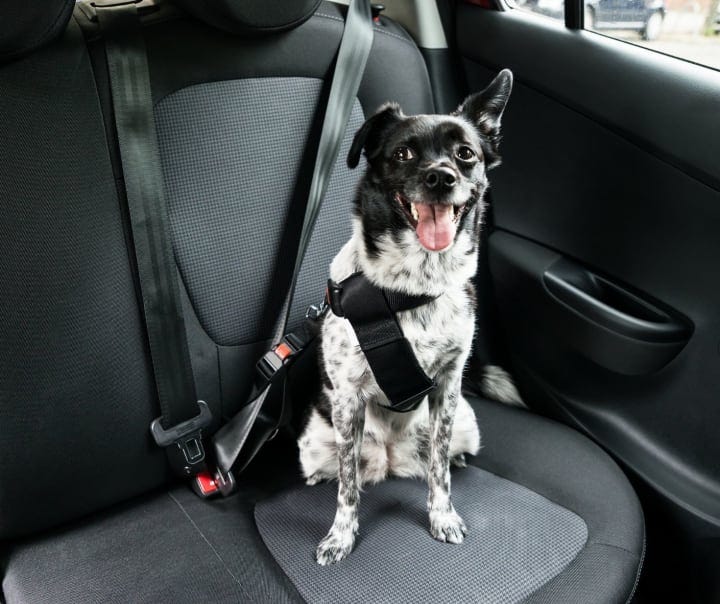
    Use carriers or seat belt restraints when traveling by car.

    Putting your dog in the back of the pickup truck is not a safe option when traveling. Many dogs jump (or fall out) and get hurt. Sometimes this causes death.

    Photo Courtesy of Canva

    Instead, put them in a carrier, so they can move around and still be safe. If you have a bigger dog, you should get a seat belt restraint. Both of these things will keep your dog safe if you are in an accident.

    Product Courtesy of Amazon

    Amazon has this great product, with two leashes that buckle into your seat belt, as well as a collapsible water bowl.

    Do a few practice car rides to see how your dog will handle a long car ride.

    Dogs can get car sick, too. They can also get anxious and really wound up in the car. Prepare for this by taking them on several short rides to see how they will react. You may have to talk to your veterinarian about getting a sedative to make the car ride a little less stressful.

    Make sure that you take a lot of breaks.

    Though many people love to rush to their destination, it is not possible with dogs. They need to take frequent bathroom breaks. Taking short walks every few hours is a good idea so that they can stretch their legs and get something to drink.

    Before you even leave for your destination (or sooner than that), make sure that your dog can stay with you at the hotel or bed and breakfast.

    Not all hotels and bed and breakfasts are dog-friendly. You need to make sure that you can find places where you can take your dog. You can’t leave him in the car overnight.

    Photo Courtesy of Canva

    Taking your dog along on vacation is a great idea, with plenty of planning. Make sure that your dog has a collar and identification. If possible, get him microchipped so, even if he gets lost, you will be able to find him. Make sure you plan ahead with where you are staying and pack appropriately. Be sure to bring his bedding, bowls, food, and water.

    Travel safely in the car with either a crate or a seat belt restraint. It might be a good idea to take a few trips around town to see how your dog reacts in the car. While on the road, be sure to take plenty of breaks and walks to keep both you and your dog limber on the long drive. With all of these tips, you should have a wonderful vacation with your furry friend.

    Product Courtesy of Amazon

    Amazon offers this all-in-one dog travel set, which is the perfect place for you to start traveling with your dog!

    ***

    Please note, this article contains affiliate links, where I will receive compensation if you buy the product, without any extra cost to you.

    ***

    It is also important to know that the information provided is for educational and informational purposes only. Although I am a veterinary professional, this blog should not be used as a substitute for professional veterinary advice. 

    If your pet is experiencing a medical problem or concern, please contact a veterinary health professional immediately. 

  • Why Do Indoor Cats REALLY Need to Be Vaccinated For Rabies?

    Photo Courtesy of Canva

    Rabies is a disease that is highly contagious to all mammals. Humans are also susceptible to the disease. Even worse, it is almost one hundred percent fatal, once clinical signs develop.

    Luckily, it is entirely preventable with a simple vaccine you give your cats and dogs. Though you may only think that your dogs and outdoor cats need the vaccine, the truth is that you should vaccinate all of your pets.

    Here are some reasons why you REALLY should vaccinate your indoor cats for Rabies

    It is a deadly disease that is preventable, with a simple vaccine. 

    Why would you want to put your family in danger if all it takes is a vaccine to prevent it? It is much better than losing your family pet or even a family member due to the horrific disease.

    Because it can be deadly, most states require all pets to have a rabies vaccine. 

    It is the law that you need to vaccinate your pet against the disease, even if he or she never goes outside.

    There is no testing for the disease, until it is too late. 

    The only way to test for rabies is by examining the tissue of the brain. This can only be done after the patient has passed away or been euthanized. It can take a few days to get results. In the meantime, other affected humans may have to go through preventive measures to ensure they are safe.

    Though you may think that your cat can’t get exposed to Rabies, the truth is that bats and other wildlife can carry the disease. 

    These can get in the house more often than you think, which makes it dangerous to have a cat that isn’t vaccinated against the disease.

    Want to go even further when it comes to protecting your pet? Here are some things that you can do to keep your pets safe from rabies (and other preventable diseases)!

    Photo Courtesy of Canva

    Vaccinate all of your dogs and cats against diseases that they can come in contact with. 

    This includes more than the Rabies vaccine. You should vaccinate dogs for Distemper, Kennel Cough (if they are around a lot of other dogs), Lyme, and Lepto. Cats should be vaccinated against Distemper and Feline Leukemia.

    You also need to keep track of when the vaccines are due. 

    You should do your best to overlap vaccines, so that you don’t let time lag between when the vaccines are due and when you give them.

    Keep cats indoors. 

    Indoor cats live healthier and happier lives. You don’t have to worry about them getting hit by cars, being attacked, or who knows what else can happen when cats roam outside.

    You may want to keep your dogs indoors as much as possible. 

    Dogs deserve to be safe too, so they shouldn’t spend time running around on their own.

    Make sure that rodent and wildlife control is important to you. 

    You may want to work with a pest control company to keep creatures from getting into your home. You should have a cap on top of your chimney and screens on all of your windows.

    Do your best to keep wildlife off your property. 

    Don’t feed stray cats, or you may soon find your yard full of wildlife that you didn’t plan on having!

    If a human or pet is ever bitten, they should wash it right away and seek medical care if needed. 

    If the medical provider is worried about rabies, it is important to contact the health department. Rabies shouldn’t be something that you ignore. You have to act fast!

    Photo Courtesy of Canva

    Though you may not want to vaccinate all of your pets against rabies, the truth is that you should. It is for everyone in your family’s protection. You don’t want to lose a family pet (or even someone in your family) because you weren’t careful!

    All it takes is a bat or other wildlife to get into your home, and rabies is possible. That being said, you can’t test for the disease without euthanasia, so you would have to put your pet down to figure out whether or not your whole family needs to be treated preventively!

    Besides vaccines, you also should keep your pets inside as much as possible, so that they are safe. You also need to work hard to keep pests and other wildlife out of your home!

    ***

    Please note that the information provided is for educational and informational purposes only. Although I am a veterinary professional, this blog should not be used as a substitute for professional veterinary advice. 

    If your pet is experiencing a medical problem or concern, please contact a veterinary health professional immediately. 

  • We Don’t Want To Talk About Money

    Photo Courtesy of Canva

    If you have read any of my other articles, you may have noticed that I have a lot to say about the veterinary world. I work very hard every day to help clients give their pets the best life possible, and it can be upsetting to hear some of the things said about us, especially when it comes to finances.

    Money can be a touchy subject, especially when it comes down to taking care of your pet. You emotionally want to do whatever you can, although you may not have the funds to do so.

    Here are some key considerations to keep in mind regarding finances and veterinary medicine.

    Although we hear it all the time, veterinary medicine is not more expensive than your own healthcare. 

    The truth is that without health insurance, you would be amazed at how much it costs to go to the doctor, let alone spend time in the hospital or have surgery.

    In fact, we should really charge more than we do. 

    Veterinary medicine is a business, and we need to generate sufficient revenue to thrive. We are constantly purchasing medications, in addition to covering our rent (or mortgage) and all the other supplies necessary to keep our office open.

    We are barely getting paid what we are worth. 

    Veterinarians graduate from veterinary school with as much debt as your own doctor, yet we don’t earn as much money as they do. Technicians and receptionists barely make enough to make ends meet. In fact, many of them have to work two or three jobs in order to survive.

    Nobody is in the business of veterinary medicine in order to make money! Please repeat this. We aren’t making as much money as you think.

    Photo Courtesy of Canva

    That being said, we all wish that we could give away everything! 

    When your pets aren’t feeling well, we want to help you as much as possible. However, we simply can’t give everything away.

    If we did this with every patient that walked in the door (or even one or two a day), it would significantly hurt the practice.

    Do not take advantage of your veterinarian’s good graces. 

    For this reason, you should never ask for discounts or see what you can get for free! Too many veterinarians will try to go above and beyond what they should in order to help you as much as possible.

    In fact, please let us know about your financial concerns before we begin. 

    If we know that you have a budget, we will do our best to get as much “bang for your buck.” If we believe that one test is more important than the others (even though you need them all to receive the best diagnosis), we will suggest that one if we know you can only afford to do one.

    If we are considering expensive medications, we may be able to find something more affordable within your price range. We may even have some medications that were donated to us that you may be able to use.

    We also want to assure you that there are no kickbacks for recommending specific food brands.

    We want to ensure that your pet has a good chance of leading a healthy life, so we recommend the brands of food that have shown good results, without the worry of recalls. If we do sell food, we aren’t making a lot of money off of it. We try to pass the savings off to you, so the profit margins on food are pretty slim.

    The same could be said about preventative medicine. 

    We recommend heartworm, flea, and tick preventatives because we have seen the consequences of a patient contracting heartworms or succumbing to a disease transmitted by fleas and ticks. To encourage you to continue purchasing the medication, we maintain a very low profit margin. We just want to ensure that your pet lives a long, healthy life.

    Photo Courtesy of Canva

    Discussing finances can be the most challenging aspect of being in veterinary medicine. We know how tight money is. Most of us live paycheck to paycheck. Some even have to work more than the recommended forty hours a week or take on another job to keep a roof over their head and food on the table.

    For this reason, please don’t comment that we don’t care about your pet and only worry about the money. It is simply not true. If we could afford to give everything away, we would! We barely break even on medications and food. We just want to ensure that they receive the care they deserve.

    Instead, let us know if you have concerns about your finances. It is much better to know how much you have to spend, then figure out how you are going to pay for it after it is all done. We may be able to identify the most important factors that could still help us obtain a decent diagnosis.

    Maybe instead of complaining, you should just thank them. It goes a long way to making us feel better and allows us to keep going.

    ***

    Can’t get enough? You can catch up on the rest of the series right here!

    The original: Things Vet Techs (and Vets) Want Pet Owners To Know

    The second part: More Things Vet Techs (and Vets) Want Pet Owners To Know

    The third part: Even More Things Vet Techs (and Vets) Want Pet Owners To Know

    Followed by: Choose the Right Pet

    The last one: We Don’t Want To Talk About Money

    Want to read the original? Catch up on it right here!

    The original: Things Vet Techs (And Vets) Are Tired of Hearing

    The second part: More Things Vet Techs (And Vets) Are Tired of Hearing

    The third part: Even More Things Vet Techs (And Vets) Are Tired of Hearing

    The last one (I think): Some More Things Vet Techs (And Vets) Are Tired of Hearing

    ***

    Please note that the information provided is for educational and informational purposes only. Although I am a veterinary professional, this blog should not be used as a substitute for professional veterinary advice. 

    If your pet is experiencing a medical problem or concern, please contact a veterinary health professional immediately.

  • Choose the Right Pet

    Photo Courtesy of Canva

    Veterinary technicians and veterinarians are here to help you have a long and happy life with your pet. However, before you go out and buy the first one you see, we want to ensure that you choose the right one.

    Here are some tips to help you choose the right pet for you and your family.

    Look closely at your lifestyle. 

    If you are busy running from one activity to another, you won’t have time for a dog that needs to spend hours outside running and getting its energy out.

    If you live on a farm, you are probably going to want a dog that wants to be out with you all the time. A smaller dog may get in the way of a tractor, so it might not be the best pet for you. However, if you live in a small apartment, a small dog might have plenty of room to exercise!

    Dogs aren’t the only pets to consider. A cat may be the perfect companion for you. They don’t need much, just food, water, and a clean litter pan. Even if you work outside the home for hours at a time, they would be content until you get home. They are not as social as dogs, so they make great pets for those who are really busy.

    Photo Courtesy of Canva

    You also need to remember that some pets need more grooming than others. 

    Many small-breed dogs and Doodles require regular grooming. Besides visiting the groomer several times a year, they often require regular brushing. You may need to set aside some time every week to keep your furry friend looking nice.

    Long-haired cats are the same way. Although you may not take them to the groomer, you will need to devote some time every week to keep their coats as nice as possible.

    As well as activity. 

    Some dogs will require significantly more exercise than others. Puppies will need to go out multiple times a day, both to use the bathroom and to play. Older dogs may not want to go out as often, so if you aren’t home as much, an older dog may be better for you.

    It is important to know that there is no such thing as a fully hypoallergenic dog or cat. 

    Dogs and cats spread allergy-causing proteins through their saliva and urine. It also sticks to their fur, which may make a fluffy dog or cat the wrong choice for a person with allergies.

    However, there are some breeds that don’t shed as much, though they may still bother someone with allergies. There are also hairless options, though they aren’t very common.

    You also need to ensure that you train your pet, especially dogs. 

    In the veterinary field, we are seeing an increasing number of young adult dogs that are out of control at the veterinarian. COVID kept everyone at home, and they were not able to socialize their dogs properly. They only know the safety of their home and the owner.

    However, there is no excuse for these dogs to be difficult to handle on a leash. You need to play with your new dog’s ears and feet so that he or she will let us clean them and trim the nails.

    Photo Courtesy of Canva

    Before you get your next pet, you need to make sure you choose wisely. You need to look closely at your lifestyle to determine what is the best pet for you. You can’t get a dog that needs to run off plenty of energy when you live in a small apartment and don’t have time for multiple walks a day.

    In fact, a dog might not be your best bet. Instead, you may want to get two cats, so that they can keep each other company while you are living your life! You also need to realize that there is no such thing as a hypoallergenic pet! Though some won’t bother your allergies as much as others, the truth is that all pets have proteins that will cause allergic reactions.

    Once you get a pet, you need to make sure you train it. Too many dogs are out of control at the veterinary office, scared of everything because they have never been exposed to anything (or anyone). You need to ensure that your dog is comfortable walking on a leash and accustomed to being handled, particularly around the ears and feet.

    ***

    Can’t get enough? You can catch up on the rest of the series right here!

    The original: Things Vet Techs (and Vets) Want Pet Owners To Know

    The second part: More Things Vet Techs (and Vets) Want Pet Owners To Know

    The third part: Even More Things Vet Techs (and Vets) Want Pet Owners To Know

    Followed by: Choose the Right Pet

    The last one: We Don’t Want To Talk About Money

    Want to read the original? Catch up on it right here!

    The original: Things Vet Techs (And Vets) Are Tired of Hearing

    The second part: More Things Vet Techs (And Vets) Are Tired of Hearing

    The third part: Even More Things Vet Techs (And Vets) Are Tired of Hearing

    The last one (I think): Some More Things Vet Techs (And Vets) Are Tired of Hearing

    ***

    Please note that the information provided is for educational and informational purposes only. Although I am a veterinary professional, this blog should not be used as a substitute for professional veterinary advice. 

    If your pet is experiencing a medical problem or concern, please contact a veterinary health professional immediately.

  • Even More Things Vet Techs (And Vets) Want Pet Owners to Know

    Photo Courtesy of Canva

    I recently started a series about things that veterinary professionals would like pet owners to know. It has been so popular (and a bit therapeutic for me), so I have continued.

    So, what else should I include in my list? Here are some more things that we want you to know.

    Though fat dogs and cats are extremely cute, it is not healthy for them. 

    Overweight dogs and cats are more likely to have medical problems, such as diabetes and heart problems. The extra weight also makes it harder on them if they develop arthritis. They will struggle more to get around than those who are at a healthy weight.

    Vomiting up hairballs is REALLY not normal. 

    Though many people believe that cats coughing up hairballs is normal, especially for those who over-groom themselves or are long-haired, the truth is that it isn’t normal. If your cat vomits hairballs regularly, you should bring it in. Your cat may have allergies, which are causing him or her to groom too much, or your cat may also have a gastrointestinal problem that needs to be dealt with.

    Vaccines are not just a one-and-done deal! 

    Photo Courtesy of Canva

    You would not believe the number of people who bring their pets in to be seen and think that they are up-to-date on vaccines. One kitten dose will not protect your cat for the rest of his or her life. Your pets will need multiple doses when they are young, and then every one to three years for the rest of their lives.

    That being said, preventive care is more cost-effective than treating problems that may occur. 

    Vaccines are cheap compared to the treatment of some of the diseases that your pet may get. Some of these, like Rabies, may be fatal if contracted, so you are going to want to make sure that your pet is well-protected.

    Many people also balk at paying money for heartworm, flea, and tick medications. However, if your dog contracts heartworms, treatment can be very expensive. Your dog may not survive treatment either! Fleas and ticks carry plenty of diseases, such as Lyme disease, so you are going to want to make sure that your pet isn’t at risk for these diseases.

    As more people switch veterinarians, your new veterinarian must have as much information about your pet as possible. 

    If you are switching veterinarians, ensure that the new veterinarian has all the records from your previous veterinarian. This needs to be done before your appointment, so we don’t waste your time during the appointment.

    This may also save you money. If we don’t see that your dog has had a recent heartworm test, we may require you to have one before we dispense any preventatives. If your pet is sick, we may recommend blood work that you may have already completed at your old veterinarian just a few days ago. Instead of repeating it, we may be able to do something different in order to come up with a proper diagnosis.

    Photo Courtesy of Canva

    As veterinary professionals, we want your pets to have the best life possible. This means maintaining a healthy weight and focusing on preventive medicine. Although you may think it is a waste of money, the truth is that it is significantly cheaper than the disease. Some diseases aren’t curable, making it even more important to get that Rabies vaccine and keep your pets on flea and tick preventative.

    ***

    Can’t get enough? You can catch up on the rest of the series right here!

    The original: Things Vet Techs (and Vets) Want Pet Owners To Know

    The second part: More Things Vet Techs (and Vets) Want Pet Owners To Know

    The third part: Even More Things Vet Techs (and Vets) Want Pet Owners To Know

    Followed by: Choose the Right Pet

    The last one: We Don’t Want To Talk About Money

    Want to read the original? Catch up on it right here!

    The original: Things Vet Techs (And Vets) Are Tired of Hearing

    The second part: More Things Vet Techs (And Vets) Are Tired of Hearing

    The third part: Even More Things Vet Techs (And Vets) Are Tired of Hearing

    The last one (I think): Some More Things Vet Techs (And Vets) Are Tired of Hearing

    ***

    Please note that the information provided is for educational and informational purposes only. Although I am a veterinary professional, this blog should not be used as a substitute for professional veterinary advice.

    If your pet is experiencing a medical problem or concern, please contact a veterinary health professional immediately.

  • More Things Vet Techs (And Vets) Want Pet Owners to Know

    Photo Courtesy of Canva

    I started a series called Things Vet Techs (and Vets) Are Tired of Hearing. Because of its popularity, I started another one, Things Vet Techs (and Vets) Want Pet Owners to Know. If you haven’t had a chance to read the first one, you can check it right here.

    However, as I went through all the things I wanted to get out there, I realized I couldn’t just write one article. It may turn into another big series that I need to write!

    So, what are some more things that vet techs (and vets) want all pet owners to know? Here are a few more for you to consider.

    Whenever you have a concern, it’s essential to consult your veterinarian first. 

    Your veterinarian and their team are here to help. Please note that I said the veterinary team. You should feel comfortable talking to anyone on the team.

    Even if you need to speak directly with the veterinarian, take the time to speak with their support staff first. 

    You may be surprised by how many questions they can easily answer without having to ask the veterinarian. They may also be able to give him or her a message and get back to you with the answer, instead of taking your veterinarian’s precious time.

    Photo Courtesy of Canva

    Look to your veterinary office first. 

    In the new age of the internet and social media, Dr. Google and Facebook friends are quick to offer plenty of advice. Some of that information might not be right at all!

    Although it might be helpful to hear some hopeful news from someone you know, whose pet is not yours, and your pet may or may not need the same treatment. In fact, it may do more harm than good, so before you follow someone else’s advice, make sure it is approved by your veterinarian.

    Be honest with your veterinarian. 

    Though you may be embarrassed by how long your dog or cat hasn’t been feeling well, we can’t help you if we don’t know the extent. Also, if you are given medicine, please let us know if you have missed any doses or if you are unable to administer it to your cat at all. Otherwise, we might wonder why the medicine isn’t working.

    This even goes for illegal substances! 

    It is going to be much easier for us if you tell us that your dog or cat got into your cigarettes or drugs. We will figure it out eventually, but it will go a lot smoother (and quicker) if we know what we are up against. We don’t have to tell anyone, but we can’t treat your pet if we have no idea what is going on.

    You also need to ask questions. 

    If you are unsure about something, don’t hesitate to ask questions. That is what your veterinary team is for. If you are struggling to get the medications in, ask them for any helpful tips.

    If you don’t understand what condition your pet is dealing with, ask for more information. They may also be able to provide you with a good website where you can conduct your own research when you’re at home and everything has sunk in.

    You also need to clearly define your own expectations. 

    Listen to what your veterinarian is saying, but then make the right decision for you. If your pet needs to receive medication multiple times a day and you don’t think you can manage it, please let them know. They might be able to give you something that may not work as well, but it only needs to be done once a day.

    If you are unable to afford the diagnostics and treatment plan that your veterinarian recommends, please let them know. When we understand what we are dealing with, we can work with you to ensure that your pet receives some relief.

    Photo Courtesy of Canva

    As a veterinary technician who works closely with a veterinarian, I want only the best for your pet. We want to help you as much as possible, so please don’t hesitate to reach out when you need us. Don’t always assume everything Dr. Google and your Facebook friends say is correct. We have years of experience and the knowledge to help.

    That being said, we need you to be honest with us. Please let us know how long the problem has been ongoing. Let us know that you haven’t followed our recommendations. Although it is hard to hear, we need to know that you cannot administer the medications, and that is why your pet isn’t getting better (and it is not something that we did wrong).

    Also, you shouldn’t be afraid to ask questions or let us know what you expect. If you can’t afford diagnostics, we may be able to try a medication to see if we can help your pet. Don’t tell us that you can’t afford blood work after it has already been run!

    ***

    Can’t get enough? You can catch up on the rest of the series right here!

    The original: Things Vet Techs (and Vets) Want Pet Owners To Know

    The second part: More Things Vet Techs (and Vets) Want Pet Owners To Know

    The third part: Even More Things Vet Techs (and Vets) Want Pet Owners To Know

    Followed by: Choose the Right Pet

    The last one: We Don’t Want To Talk About Money

    Want to read the original? Catch up on it right here!

    The original: Things Vet Techs (And Vets) Are Tired of Hearing

    The second part: More Things Vet Techs (And Vets) Are Tired of Hearing

    The third part: Even More Things Vet Techs (And Vets) Are Tired of Hearing

    The last one (I think): Some More Things Vet Techs (And Vets) Are Tired of Hearing

    ***

    Please note that the information provided is for educational and informational purposes only. Although I am a veterinary professional, this blog should not be used as a substitute for professional veterinary advice.

    If your pet is experiencing a medical problem or concern, please contact a veterinary health professional immediately. 

  • Things Vet Techs (And Vets) Want Pet Owners to Know

    Photo Courtesy of Canva

    I wrote a series entitled Things Vet Techs (and Vets) Are Tired of Hearing. This sparked many blogs that you can read if you are interested.

    However, the truth is that, due to their popularity, I decided to write a new series about what vet techs and veterinarians want pet owners to know. Curious about what vet techs (and vets) really want to tell you?

    Here are some of those things.

    Dry food doesn’t help them with dental problems. 

    Most owners have long believed that feeding their cats dry food is necessary to keep their teeth clean. However, that simply isn’t the case at all. The only thing that will help keep your pets’ teeth clean is by brushing their teeth or giving them rawhide bones and other things to chew on.

    Photo Courtesy of Canva

    Dental care is really important for our pets. 

    Although many owners claim they have never had their dogs’ or cats’ teeth cleaned before, the truth is that it is necessary. Dental disease can lead to more problems in the future, such as kidney, heart, and liver disease. For this reason, you should start brushing now, and when your veterinarian advises that your pet needs to have its teeth cleaned, ensure that you follow the recommendations.

    In fact, bad breath is often a sign of dental disease. 

    If you are concerned that your pet has bad breath, you should consult your veterinarian. Your pet will likely need to have their teeth professionally cleaned. Your veterinarian may also need to remove some teeth to maintain their oral health as much as possible.

    You should NEVER give your pet a breath mint instead! 

    Breath mints for humans often contain Xylitol, which can be toxic for your pet. This may lead to an even bigger veterinary bill, with no guarantee that your pet will recover.

    You should be aware of some common toxicities that affect the pets you have. 

    Dogs should never be allowed to have grapes, raisins, onions, or garlic. They can’t have caffeine and chocolate. Xylitol, which is in breath mints and certain peanut butter, can be deadly.

    Cats can’t be anywhere near lilies, though they also can’t have onions and garlic. Antifreeze is one thing that cats always want, but they should never have. You also should never leave any of your dog’s flea medications out. This can be deadly to cats.

    Both dogs and cats need to stay away from human medications and substances used to bait mice, rats, and even snails. These contain poison that will slowly kill your beloved pet.

    Because of this, you should never give your pet any of your own medication without a prescription. 

    There are numerous human medications that can be fatal to our pets. Though your vet may prescribe your pet something that you take, it is just as easy to overdose them by trying to do it yourself. And dogs should NEVER be given aspirin.

    Photo Courtesy of Canva

    Veterinarians want your pets to live as long as possible by maintaining their health. One way to do this is by making sure that you take care of their teeth. Dental disease can lead to numerous serious problems, so if we recommend a cleaning, you may want to ask us more about it.

    You should also be aware of things to avoid. Dogs and cats can easily die if they eat something they shouldn’t. This also includes some of our own medications. You should never give your dog or cat aspirin or any other medication in your home without our advice.

    ***

    Can’t get enough? You can catch up on the rest of the series right here!

    The original: Things Vet Techs (and Vets) Want Pet Owners To Know

    The second part: More Things Vet Techs (and Vets) Want Pet Owners To Know

    The third part: Even More Things Vet Techs (and Vets) Want Pet Owners To Know

    Followed by: Choose the Right Pet

    The last one: We Don’t Want To Talk About Money

    Want to read the original? Catch up on it right here!

    The original: Things Vet Techs (And Vets) Are Tired of Hearing

    The second part: More Things Vet Techs (And Vets) Are Tired of Hearing

    The third part: Even More Things Vet Techs (And Vets) Are Tired of Hearing

    The last one (I think): Some More Things Vet Techs (And Vets) Are Tired of Hearing

    ***

    Please note that the information provided is for educational and informational purposes only. Although I am a veterinary professional, this blog should not be used as a substitute for professional veterinary advice. 
     

    If your pet is experiencing a medical problem or concern, please contact a veterinary health professional immediately.